Home › Blog › The 5 types of health insurance under 65
What Are the 5 Types of Health Insurance for People Under 65?
Written and reviewed by Dick Tracy, licensed health insurance broker (NPN 20414610) · Published September 2, 2026 · Updated October 2, 2026
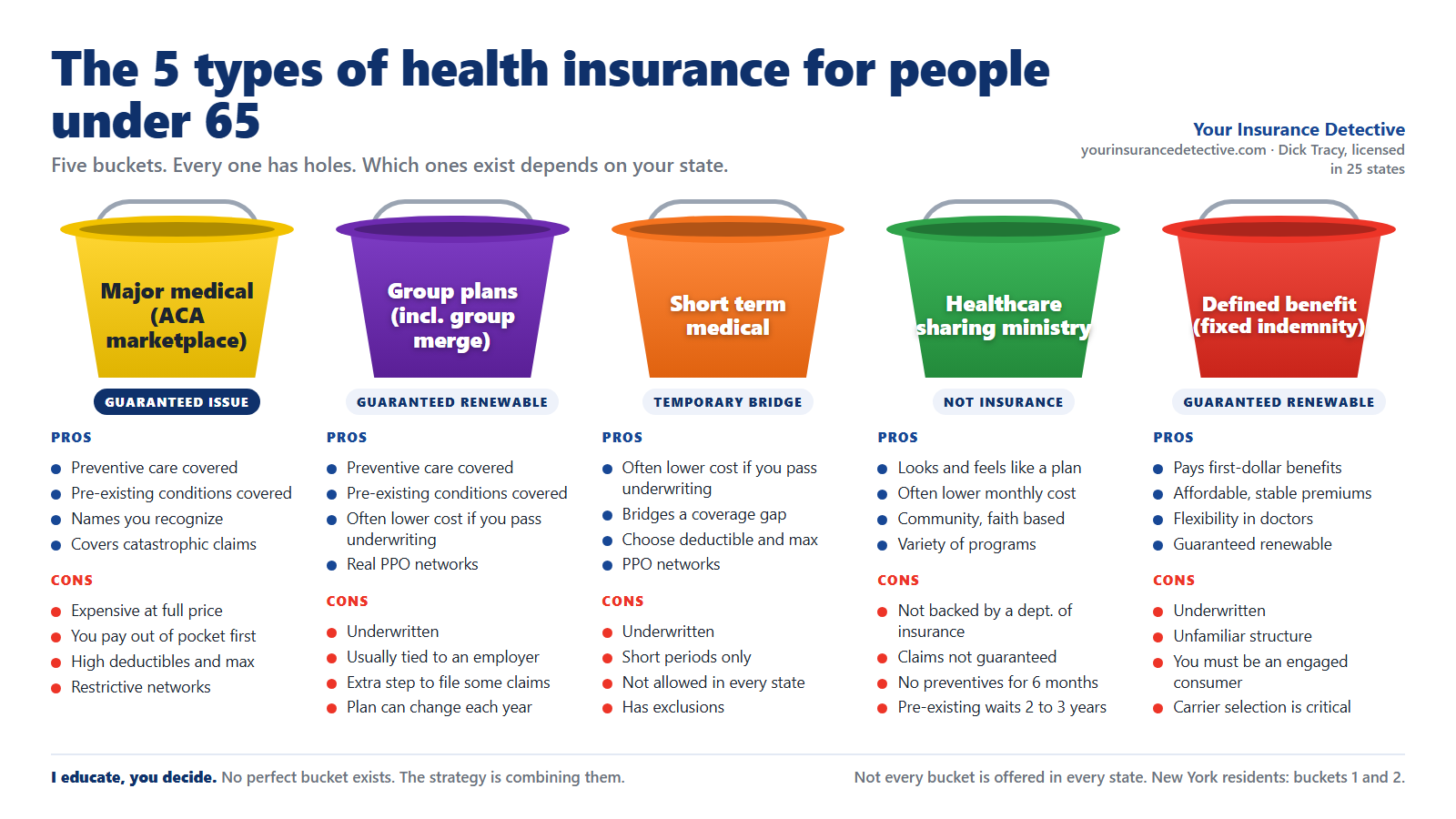
⬇ Download the chart
Quick answer For people under 65 in the United States, private health coverage comes in five types. I call them the five buckets: (1) major medical through the ACA marketplace, (2) group plans, including pre-established group plans an individual can merge into, (3) short-term medical, (4) healthcare sharing ministries, and (5) defined benefit plans, also called fixed indemnity. Only the first bucket is guaranteed issue. Two of the five are not written for New York residents, and one of the five is not insurance at all. The yardstick everything gets measured against is real money: KFF's 2025 Employer Health Benefits Survey puts the average group premium at $9,325 a year for one person and $26,993 for a family. I'm Dick Tracy, a licensed health insurance broker in Buffalo, NY. Every bucket has holes. The job is knowing which holes you can live with.
I'm a health insurance broker in Western New York, licensed in 25 states with 80+ carriers behind me. I came out of the healthcare side of this business, so there is no gag clause on me. When someone asks me what their options are, I do not start with a quote. I start with the map. Here are the five buckets, which states they exist in, and the tips, the tricks, and the traps in each one.
Two words that sort every bucket: guaranteed issue and guaranteed renewable
Guaranteed issue means the carrier has to take you no matter what your health history looks like. In the under-65 world that describes exactly one bucket, the marketplace, and only during open enrollment or a special enrollment window. Guaranteed renewable means a different promise: the carrier can ask health questions to let you in, but once you are in, it cannot cancel you or single you out for a rate increase because you got sick. Group plans and defined benefit plans work that way. Short-term plans make neither promise, because the term ends. A healthcare sharing ministry makes neither promise either, because it is not an insurance contract. Keep those two words in your pocket and the rest of this page is easy.
Bucket one (yellow): major medical through the ACA marketplace
This is the bucket everybody knows, whether they call it the marketplace, Obamacare, or the ACA. Plans are guaranteed issue, every one of them covers the ten essential health benefits, preventive care is included, pre-existing conditions are covered from day one, and the carrier names are ones you recognize. It is also the only bucket with a government subsidy attached: if your household income lands under the 2026 subsidy cliff at 400% of the federal poverty level, a premium tax credit lowers the price. The free 2026 subsidy cliff calculator tells you in 60 seconds whether you are under the line.
The holes: at full price it is expensive, and the price goes up every year. You pay out of pocket first, because the deductibles and out-of-pocket maximums are high. Networks are restrictive, and most marketplace plans are not a true PPO no matter what the brochure implies. If you are over the cliff and reasonably healthy, this bucket makes you pay to have it and pay again to use it. If you have had a serious diagnosis in the last five years, guaranteed issue makes it the right tool for now, and I will tell you so.
Bucket two (purple): group plans, including the group merge nobody mentions
A group plan is coverage bought for a group of people rather than one person. It covers preventive care and pre-existing conditions, it is guaranteed renewable, it usually comes with a real PPO network, and the rate is set on the group instead of on the sickest people in an entire state's individual pool. That is why an employer plan feels cheap: the employer pays most of it and the group rate is better to begin with.
Here is the part almost nobody explains. There are different kinds of group plans. The traditional one belongs to an employer, and that is its biggest hole: the employer owns the rights to it, so when you leave the job the coverage leaves with you, and if your health has changed you get pushed into the guaranteed-issue bucket. But there are also pre-established group plans that an individual can merge into and get group rates without being anyone's employee. The mechanism is federal law, ERISA, from 1974, which overrides state community rating. You get the group rate, a true PPO, and a policy you own no matter who you work for. It is a simple compliance step I walk you through. I wrote the whole thing up here: pre-established ERISA group plans, the New York cheat code.
The holes: group plans are underwritten, so a serious recent diagnosis can keep you out. Some group plans ask the provider to take an extra step when filing a claim. And any group plan can change its benefits from one year to the next, which is a reason to read the renewal instead of auto-paying it.
Bucket three (orange): short-term medical
Short-term medical is a temporary plan written for a fixed period. It is often lower cost for people who pass underwriting, you choose the deductible and the out-of-pocket maximum, it usually runs on a PPO network, and it can bridge a gap between two other plans.
The holes are the reason I almost never reach for this bucket. It is underwritten. It can only be written for a short period, and when the period ends, so does the coverage. It has exclusions, and pre-existing conditions are generally not covered at all. Not every state has it: short-term plans are not sold in more than a dozen states, including New York, New Jersey, and California, and several others limit them. If you have a gap to bridge, there is usually a better move, and the most common one is the COBRA election window itself, which is retroactive and gives you 60 days to shop. I explain that play on the COBRA alternatives page.
Bucket four (green): healthcare sharing ministries
A healthcare sharing ministry looks and feels like a health plan. Members pay a monthly amount into a pool, the pool pays eligible medical bills, the monthly number is often lower than a marketplace plan, and the programs are built around a community or a faith. There is real variety in how they are run.
Now the sentence the marketing leaves out: a healthcare sharing ministry is not insurance. It is not backed by a state department of insurance, and no claim is guaranteed. Preventive care is usually not shared for the first 6 months, and pre-existing conditions typically wait 2 to 3 years. When a pool runs dry, the members are the ones holding the bills. I am appointed with some of these programs and I almost never write one, because I cannot promise you a claim gets paid and neither can they. If you go this route, go with your eyes open, and treat it as a shared-expense club, not as a policy.
Bucket five (red): defined benefit, also called fixed indemnity
A defined benefit plan flips the whole model. Instead of paying a percentage of the bill after a deductible, it pays a set dollar amount for each covered service, first dollar, straight from the schedule in the brochure, in or out of network. Premiums are affordable and stable, it is guaranteed renewable, and because it pays you rather than the provider, you keep the flexibility to see the doctor you want and to shop the cash price. When the set benefit is more than the cash price, you keep the difference.
The holes: it is underwritten. The structure is unfamiliar, so people who expect a copay card get confused. You have to be an engaged consumer, because the plan rewards asking for the cash price and submitting the itemized receipt. And carrier selection is critical, because the benefit schedules vary wildly. This bucket exists in states with private underwriting, and it is not written for New York residents. In the states where it lives, I use it as the foundation of a plan, not the whole house.
The five buckets side by side
| Bucket | Who gets in | Once you are in | Best for | Biggest hole | Where it exists |
|---|---|---|---|---|---|
| 1. Marketplace (major medical) | Anyone, during open enrollment or a 60-day special enrollment window | Guaranteed issue. Renews every year at that year's price. | A recent serious diagnosis, or a household under the 2026 subsidy cliff | Full price over the cliff, high deductibles, narrow networks | All 50 states |
| 2. Group plans | Employees of a group, or an individual who merges into a pre-established group plan after underwriting | Guaranteed renewable | Healthy people and families who want group rates and a true PPO | Underwriting. A traditional employer plan belongs to the employer, not to you. | All 50 states. The group merge is the door I open first for healthy New Yorkers. |
| 3. Short-term medical | People who pass underwriting, for a fixed term | Coverage ends when the term ends | Bridging a gap of a few months | Exclusions, no pre-existing coverage, and it is not a long-term plan | Not sold in more than a dozen states, including New York, New Jersey, and California; limited in others |
| 4. Healthcare sharing ministry | Members who agree to the program's rules | No contract of insurance, no guaranteed claim | People who accept that bills are shared, not owed | It is not insurance. No state guarantee stands behind a claim. | All 50 states, but not regulated as insurance |
| 5. Defined benefit (fixed indemnity) | People who pass underwriting | Guaranteed renewable | A foundation for everyday claims and a cash-pay strategy | Pays set amounts, so a very large claim needs a roof on top | States with private underwriting. Not written for New York residents. |
Availability by state reflects the plans I write as a licensed broker in 25 states and each state's individual-market rules. Guaranteed issue and guaranteed renewable are defined in the plan documents, not in the sales pitch.
Which buckets exist in your state
This is the part the national articles skip, and it is the part that decides everything. The rules on private underwriting are set state by state.
New York residents have buckets one and two: the New York marketplace, and group plans, including the pre-established group merge. New York does not allow short-term plans and does not allow individual plans to be priced on your health, and I do not write defined benefit plans for New York residents. Healthy New Yorkers over the subsidy cliff start with the group merge. Everyone else starts with the marketplace. Details on the New York page.
New Jersey and California residents are in the same shape: no short-term plans, no underwritten individual plans, so buckets one and two carry the load, with supplemental layers on top. See New Jersey and California.
States with private underwriting, which is most of the other states I am licensed in, have all five buckets. Florida, Texas, Ohio, Georgia, Pennsylvania, North Carolina, Michigan, Indiana, Arizona, Tennessee, and more. For a healthy person over the cliff, an underwritten plan priced on your own health, or a defined benefit foundation with a catastrophic roof, is often the best value on the board. Start with Florida, Texas, or Ohio, or take the 60-second quiz and pick your state there.
No perfect bucket: the build-a-house strategy
Every bucket has holes. That is not a complaint, it is the whole point. Once you can see the holes, you stop looking for the one perfect plan and start combining. In states with private underwriting, a defined benefit plan handles the everyday claims as the foundation, a high-deductible major medical plan sits on top as the roof for the big-ticket stuff, and cheap add-ons like accident and critical illness fill the gaps. In New York, the group merge is the foundation and the supplemental layers still apply. The goal is the same everywhere: you leave the hospital with a check in the mail, not a bill. I walk through the whole thing in the build-a-house strategy.
Common questions about the five types of health insurance
What are the 5 types of health insurance for people under 65?
The five types of private health coverage for people under 65 are: major medical through the ACA marketplace; group plans, including traditional employer plans and pre-established group plans an individual can merge into; short-term medical; healthcare sharing ministries; and defined benefit plans, also called fixed indemnity. Only the marketplace is guaranteed issue. Group plans and defined benefit plans are guaranteed renewable after underwriting. Short-term plans end when their term ends, and a healthcare sharing ministry is not insurance at all. Medicare, Medicaid, and CHIP are public programs and sit outside these five.
Which type of health insurance is the cheapest?
It depends on two things: your income and your health. If your household income is under the 2026 subsidy cliff at 400% of the federal poverty level, the marketplace with a premium tax credit is usually the cheapest door, and sometimes the only one that makes sense. If you are over the cliff and reasonably healthy, an underwritten plan, a defined benefit plan in a private-underwriting state, or a pre-established group plan you merge into is often lower cost than an unsubsidized marketplace plan. The full price you are trying to beat is real: KFF's 2025 Employer Health Benefits Survey puts the average group premium at $9,325 a year for one person and $26,993 for a family. Cheapest on the day nothing happens is not the same as cheapest on the day something does.
What is the difference between guaranteed issue and guaranteed renewable?
Guaranteed issue means the carrier must accept you regardless of your health history, which is how the marketplace works during open enrollment and special enrollment windows. Guaranteed renewable means the carrier can ask health questions before it lets you in, but once you are in it cannot cancel you or single you out for a rate increase because you got sick. Group plans and defined benefit plans are guaranteed renewable. Short-term plans and healthcare sharing ministries are neither.
Can I get a group health plan without an employer?
Yes. There are pre-established group plans that an individual can merge into and get group rates without being anyone's employee. The mechanism is federal ERISA law from 1974, which overrides state community rating, so healthy people even in New York can get a group rate, a true PPO network, and a policy they own no matter who they work for. It is underwritten, so a serious recent diagnosis can keep you out, and it is a simple compliance step a broker walks you through rather than something you enroll in online.
Is a healthcare sharing ministry health insurance?
No. A healthcare sharing ministry is a group of members who agree to share each other's medical bills. It is not a contract of insurance, it is not backed by a state department of insurance, and no claim is guaranteed. Preventive care is usually not shared for the first 6 months and pre-existing conditions typically wait 2 to 3 years. The monthly cost can look attractive, but if the pool runs short the members hold the bills. I am appointed with some of these programs and almost never write one.
Tell me your state, your household, and roughly where your income lands, and I will tell you which of the five buckets are open to you and which one I would start with. One call, no hard sell. I educate, you decide.
Grab a time right here
Pick a slot below and it lands on both our calendars. No phone tag, no hard sell. I educate, you decide.